The science behind LED light
Using low-level light on the skin has been studied for decades. Researchers call it photobiomodulation (PBM), or low-level light therapy. It uses gentle light that does not heat or break the skin, which is why it is often described as non-thermal and non-ablative.
We think you should know what the research actually looked at before you decide whether a light mask is for you. So on this page we walk through one published, controlled trial in detail, including the parts that limit what it can tell you.
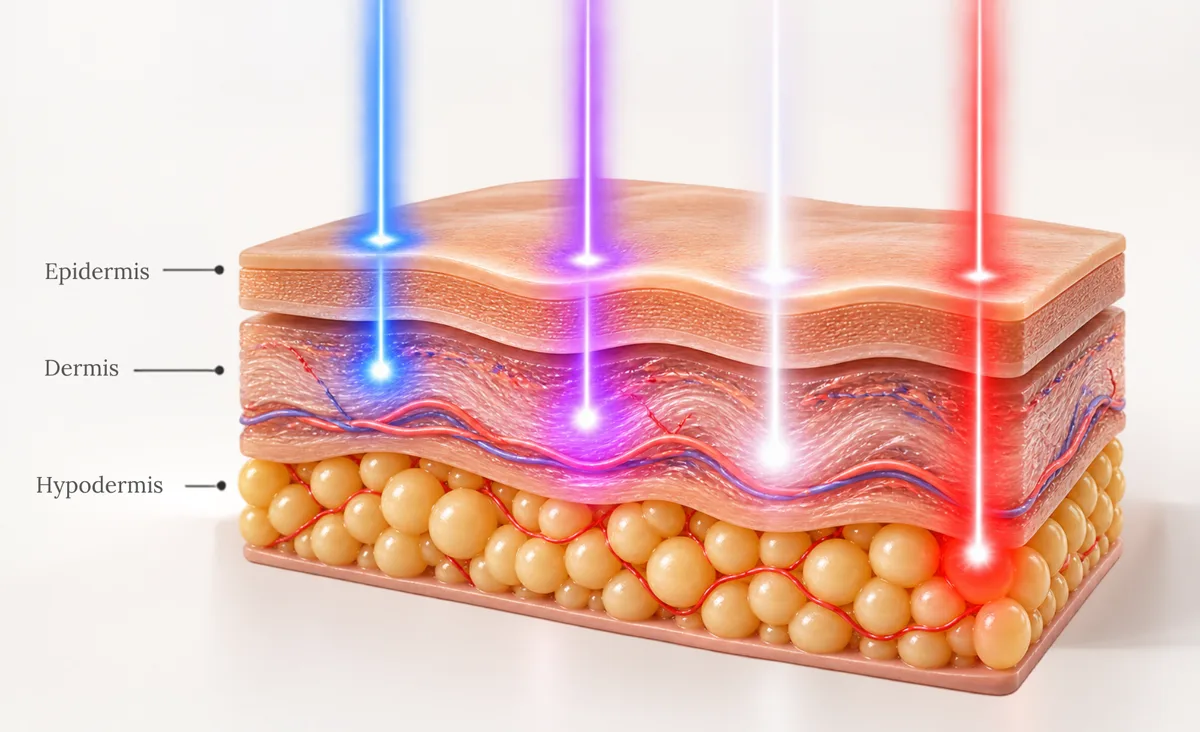
How light and skin interact
Red light (roughly 600–700 nm) and near-infrared light (roughly 700–1,000 nm) reach further into skin than blue or violet light. Researchers propose that this light is absorbed by parts of the cell's energy machinery in the mitochondria, and that this may change how cells such as fibroblasts, the cells that make collagen, behave. Laboratory work has looked at effects on energy production (ATP), cell signalling and gene activity.
Much of this comes from cell and laboratory studies. How strongly it shows up in real skin depends on the wavelength, the strength of the light and how long and how often it is used.
The four GLOAM modes, left to right
- Blue mode470 nm blue
- Purple mode410 nm violet850 nm near-infrared
- White mode465 nm white (blue-based LED)850 nm near-infrared
- Red mode630 nm red850 nm near-infrared
One controlled trial, in detail
Photomedicine and Laser Surgery, 2014
A controlled trial to determine the efficacy of red and near-infrared light treatment in patient satisfaction, reduction of fine lines, wrinkles, skin roughness, and intradermal collagen density increase
Alexander Wunsch and Karsten Matuschka. Photomed Laser Surg. 2014;32(2):93–100.
- Who took part
- 136 adult volunteers aged 27 to 79 in Germany; 128 completed the course.
- Groups
- Four light groups assigned by computer randomisation, compared with 23 people who received no light.
- Light used
- Red light (611–650 nm) alone, or a broader 570–850 nm band that also covers near-infrared.
- Dose
- About 9 J/cm² of red light per session, 12 to 25 minutes a session, twice a week.
- How long
- 30 sessions over roughly four months (January to June 2012).
- How it was measured
- 20 MHz ultrasound for collagen density, 3-D surface scans for roughness, and before/after photos judged by three physicians who did not know which was which.
What the researchers measured after 30 sessions
| Measure | Red light only | Red + near-infrared | No light |
|---|---|---|---|
| Collagen density score (higher is better) | +5.75 | +6.40 | −0.26 |
| Skin roughness, Ra (lower is better) | −1.79 | −1.58 | +0.95 |
| Photos judged better by the blinded panel | 40 of 57 | 36 of 48 | 1 of 23 |
Both light groups rated their skin complexion and skin feel better after the course, and the differences from the start were statistically significant. The group that received no light showed no change in collagen density, and its photos were mostly judged the same or worse, which the authors link to the move from winter to summer sun.
“Broadband polychromatic PBM showed no advantage over the red-light-only spectrum.”
In other words, adding the wider band of light did not do better than red light on its own, at the doses used.
Side effects reported
No one left the study because of a side effect, and no serious side effects were recorded, including at the six-month follow-up. Two mild events were noted: one person found existing small facial veins looked more visible and covered those areas, and one person had redness over a 40-year-old knee scar that settled within a week.
What this study does not tell you
- The volunteers sat or lay in large full-body or face-and-chest lamp units. No LED face mask was used, and the GLOAM mask was not part of the study.
- The comparison group was not randomised: it was mostly staff of the company that made the lamps, and it received no light at all, not a placebo light.
- The study was fully funded by the lamp maker, JK-Holding GmbH, which also supplied the equipment. The lead investigator was paid by the sponsor to run it.
- Volunteers rated their own skin, so the people having sessions knew they were having them.
- It is one study. Light research uses many different wavelengths, strengths and session lengths, and results from one setup do not carry over automatically to another.
How this relates to the GLOAM mask
Light used in the study
The study used red light from 611 to 650 nanometres, or a broader band from 570 to 850 nanometres. The GLOAM mask uses 410 nm in purple mode, 465 to 470 nm in blue and white modes, 630 nm in red mode, and 850 nm near-infrared in the red, purple and white modes.
White lines mark the mask's wavelengths. Its 630 nm red sits inside the study's red band, and its 850 nm near-infrared is at the top of the broader band. Ultraviolet starts below 400 nm, off the left of this chart.
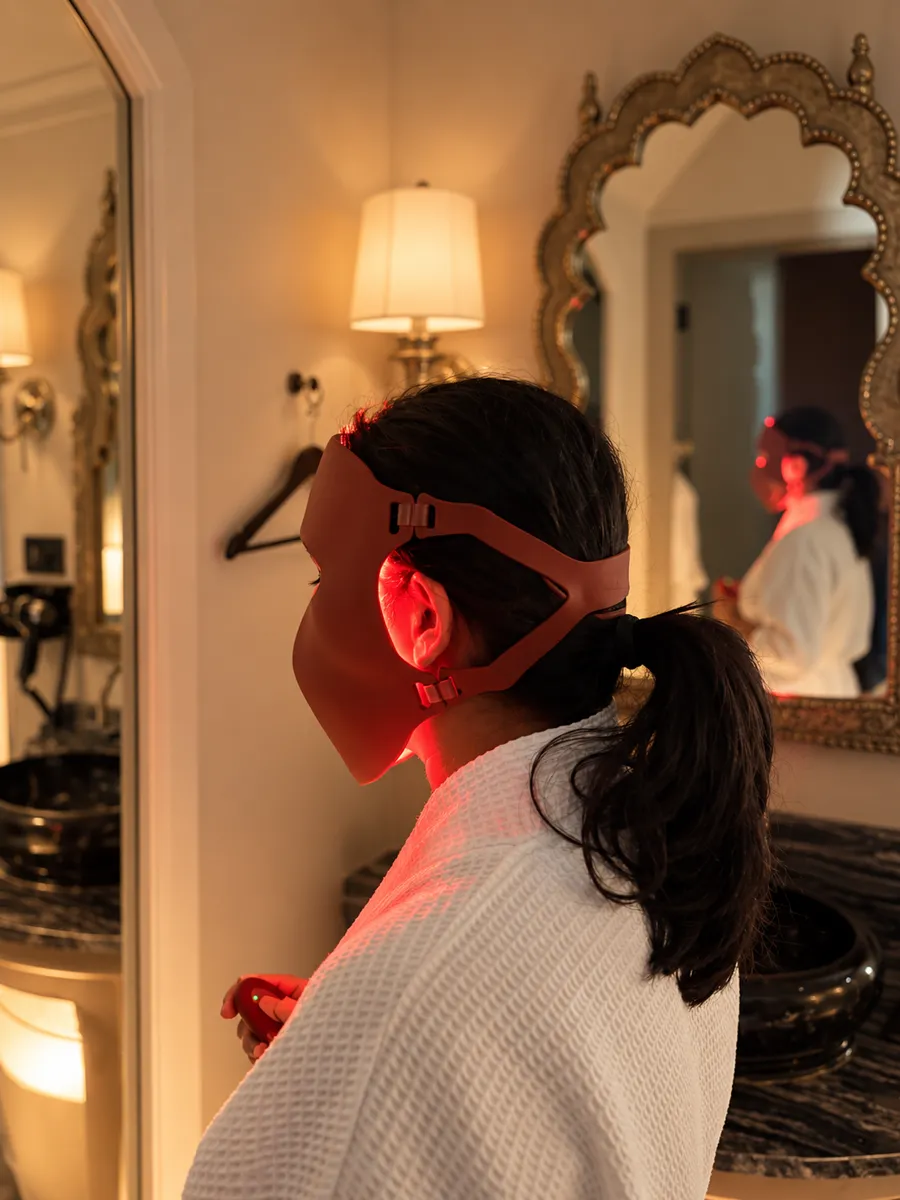
The GLOAM Twilight Beauty Mask has a red mode at 630 nm, which sits inside the 611–650 nm red band used in this study, and near-infrared LEDs at 850 nm, the upper end of the study's broader band. Its blue, purple and white modes were not part of this study.
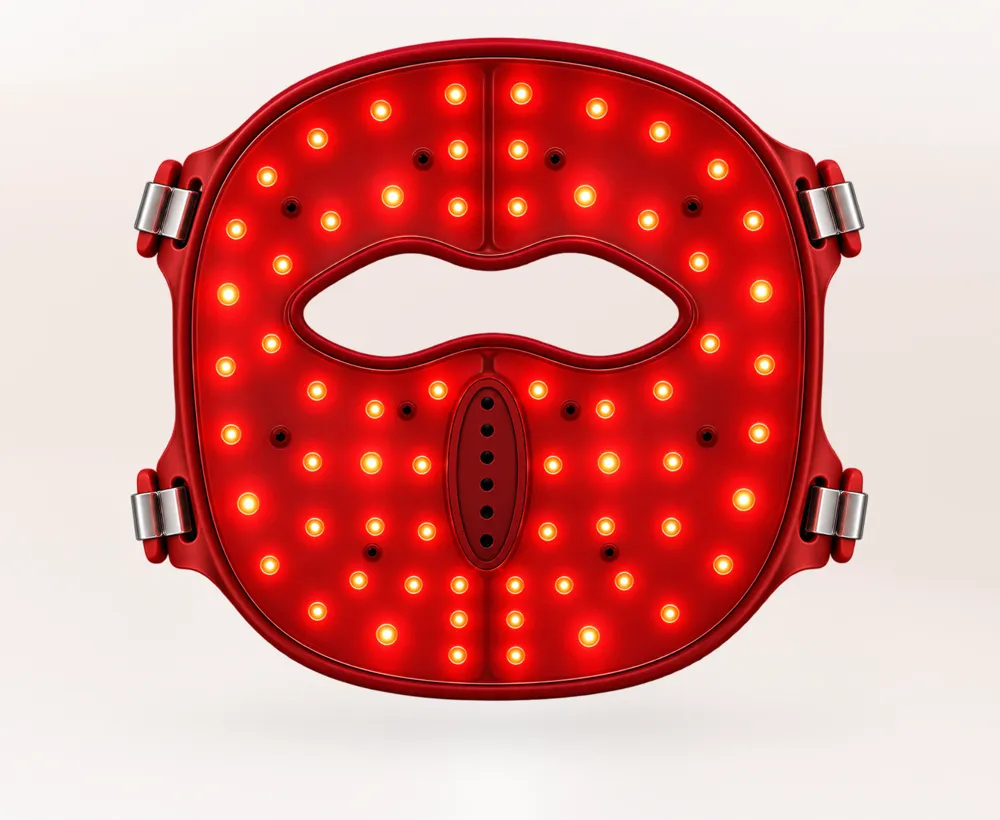
We have not measured how much light the mask delivers per session, so we cannot say how its dose compares with the study. The mask was not tested in this trial, and we do not claim it gives the results above. It is a cosmetic device for at-home use, not a medical device. Please read our safety information and how to use guide before your first session.
Reference
Wunsch A, Matuschka K. A controlled trial to determine the efficacy of red and near-infrared light treatment in patient satisfaction, reduction of fine lines, wrinkles, skin roughness, and intradermal collagen density increase. Photomedicine and Laser Surgery. 2014;32(2):93–100. doi:10.1089/pho.2013.3616. Free full text on PubMed Central (PMC3926176).